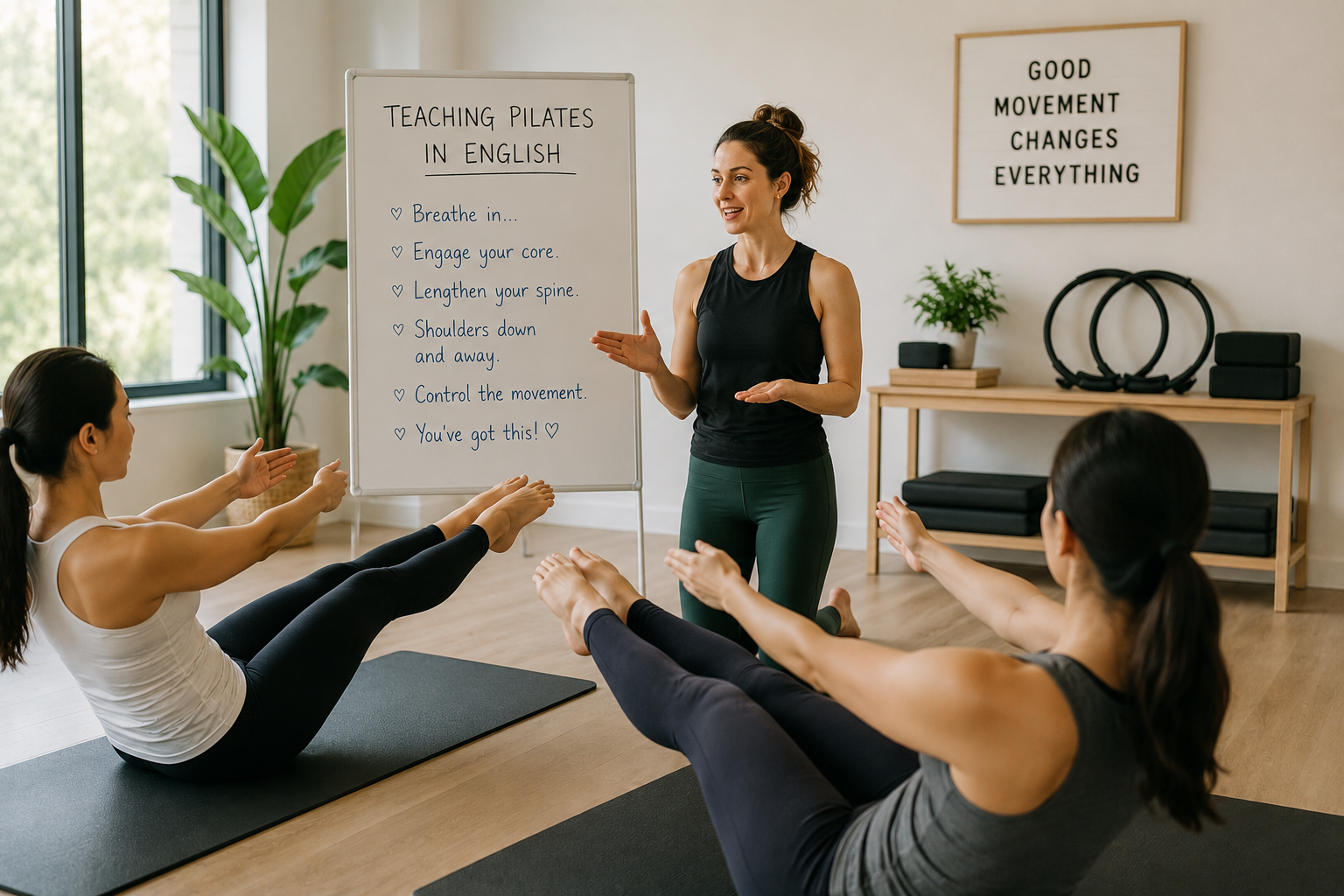
Open Doors With English For Pilates
For years, I kept my Pilates teaching and my English teaching as two completely separate businesses. It never though to combine them.
Then one day, a Pilates teacher in training from Korea contacted me.
She needed to complete her certification course, and pass her practical exam, in English. Every week, she came to class with her lesson plans and scripts for teaching each exercise. Together, we worked through the language, replacing difficult phrases with cueing that sounded natural, was easy to remember, and still communicated exactly what she wanted her clients to do.
After that came a teacher from Türkiye.
Then another from Taiwan.
That's when I realized this wasn't a coincidence. Around the world, Pilates teachers are trying to teach in English, but there are very few resources designed specifically for them.
Ironically, I'm on the opposite journey.
I teach Pilates in my native language, English, but I've been learning Spanish for years. I can hold conversations comfortably at about a B1 level, but I still can't teach a Pilates class in Spanish.
And I've tried.
Teaching Pilates requires so much more than knowing the language. You're demonstrating exercises, watching movement, correcting, planning the next exercise, keeping the class flowing, and trying to sound calm and confident—all at the same time. It isn't just vocabulary. It's a completely different way of thinking.
Because I've experienced that frustration myself, I understand what you're going through.
In The Conversation Studio, we'll work through Pilates the same way you teach it.
We'll practice cue by cue, acting out the exercises as we go. We'll learn natural language for instructions, transitions, polite corrections, and more. If you're teaching the classical mat, we'll work through all 34 exercises. If you're a reformer teacher, we'll step onto the reformer and build the language exercise by exercise.
The goal isn't to sound like a native speaker.
The goal is to become a confident teacher who can communicate what you need your client to do and keep them safe.
Teaching in a second language will probably always feel harder than teaching in your first. You may need more time to find the right words, and sometimes you'll wonder if you're saying it correctly. It's humbling.
That's okay.
Your clients don't expect perfection. They expect knowledge, professionalism, and kindness.
My Pilates mentor used to remind me:
"Just smile—they'll love you."
So, smile, trust what you already know, and don't worry if you are not perfect.
The English will come.
If you're ready to teach Pilates to an international audience, I'd love to help.
I'll see you on the mat.